
You must determine your personal space requirements before selecting a model, as the correct size depends on your physical height and how much room you need to move while seated or lying down.
If you are new to heat therapy, browse our comparison of easy portable saunas for beginners.
Which Interior Dimensions Suit Your Needs?
| If this is you | The Interior Dimensions that suit you | Why |
|---|---|---|
| A single user seeking a compact, space-saving setup | 3 ft to 4 ft wide | This width provides enough room for one person to sit comfortably without feeling cramped against the walls. |
| A person who prefers to lie down or recline during use | 5 ft to 6 ft long | Longer interior dimensions ensure your feet do not hit the front wall and allow for a full-body reclining position. |
| A couple sharing a session together | 6 ft to 7 ft wide | A wider interior allows two people to sit side-by-side with enough clearance to move their arms and legs. |
| A user who requires significant room for movement or stretching | 7 ft or more in any direction | Larger dimensions provide the clearance needed for active stretching or moving between different seated positions. |
Examples from this category, each with its own review here
3 options shown here, $1199.99 to $2580, each with its own full review behind its name.
You can find high-quality options in our list of backyard saunas under $2600.
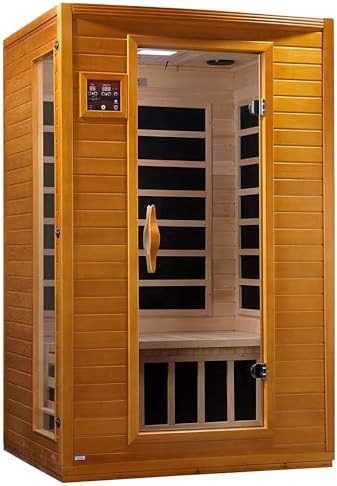


How Do I Measure My Space for a Portable Sauna?
Measuring your available space involves more than just checking the floor area where the unit will sit. You must determine the clearance needed for the unit’s operation and the physical footprint it occupies once fully inflated or assembled. Most manufacturers list interior dimensions in the product specifications, often near the weight and heating capacity figures.
Couples can explore the best 2 person portable steam sauna for shared sessions.
For targeted physical therapy, see how to find the best infrared sauna for muscle tension.
Measuring the Floor Space for the Sauna
Use a standard tape measure to map out the area where the portable sauna will be placed. Measure the length and width of the clear floor space, ensuring you account for the exterior footprint of the unit. Because portable saunas often have a base that extends slightly beyond the interior walls, you should add at least 12 inches of buffer space to both the length and width of the interior dimensions provided in the listing. This ensures the unit does not sit flush against walls or furniture, which can interfere with the stability of the structure or the circulation of air.
If you prefer a more compact heat source, view our guide to the best infrared sauna blanket for relaxation.
Verifying Interior Dimensions in Product Listings
Locate the “Interior Dimensions” or “Internal Size” section in the manufacturer’s technical specifications. These figures represent the usable space inside the sauna walls, not the exterior size of the package or the folded unit. If a listing provides only a single number, it often refers to the width of the unit. You should look for a pair of numbers—length and width—to understand the shape of the interior. If the listing only provides a total square footage, you must divide that number by the width to estimate the length, though this can vary based on the specific shape of the sauna’s interior.
Compact living requires a different approach; see our guide to the best portable sauna for small spaces.
What Happens if the Interior Dimensions Are Wrong?
Choosing interior dimensions that are too small results in a cramped environment where your limbs may press against the walls. This can make it difficult to find a comfortable seated position or feel restricted during a session. If the space is too narrow, the heat may also feel more intense because your body is in closer proximity to the heating elements or the walls of the sauna.
For high-moisture experiences, look at our comparison of the best portable steam tent with steamer.
Budgeting for your setup is easier when you see what different price levels get you for portable saunas.
The Impact of Choosing a Unit That Is Too Small
Small interior dimensions limit your ability to change positions during a session. If you are a taller person, a small unit might force you to sit in a rigid upright position because there is no room to lean back. This can lead to physical discomfort and a shorter session duration. Many users assume a small unit is sufficient for a single person, but if the interior width is less than 3 ft, even a single user may find the space restrictive for anything other than a stationary seated position.
To better understand your options, see the various types of portable saunas explained.
The Impact of Choosing a Unit That Is Too Large
Selecting interior dimensions that are too large for your needs can lead to inefficient heating. A larger volume of space requires more energy and time to reach the desired temperature because the heat must distribute across a greater area. If the interior is significantly larger than the number of people using it, you may find that the heat feels less concentrated. This can result in a longer wait time before the sauna reaches a comfortable temperature. Conversely, if the space is too large for the heating capacity of the unit, the temperature may never reach the peak level listed in the specifications.
Newcomers should start by viewing how portable saunas work and what they are.
What Should I Do if I Fall Between Two Sizes?
Deciding between two different interior dimensions often comes down to your primary activity while using the portable sauna. If you are choosing between a 4 ft wide and a 6 ft wide unit, you must decide if you prioritize a compact footprint or the ability to sit side-by-side with another person. If your priority is comfort and movement, the larger dimension is the safer choice to ensure you do not feel restricted.
If a traditional cabin isn’t feasible, look into various portable sauna alternatives and results.
Detailed specifications are available in our full X-Vcak KC-S01 Sauna review.
Prioritizing Movement Over Footprint
When you are caught between two sizes, choose the larger interior dimension if you plan to use the sauna for more than 15 minutes at a time. Movement is essential for comfort in a confined space. If you choose the smaller option to save space in your home, you must be prepared to remain in a fixed position for the duration of the heat. If you are unsure, check the height of the interior walls. A taller interior can sometimes compensate for a narrower width by allowing you to sit in a way that feels less confined.
Check out our full SLISAU40BK Portable Sauna review for a technical breakdown.
Balancing Size and Heating Capacity
If choosing a larger interior dimension, you must verify the heating capacity of the unit to ensure it can heat the extra volume. A larger space requires a more powerful heating element to reach target temperatures quickly. If the heating capacity is not stated in the listing, you should contact the manufacturer to confirm the unit can maintain heat in the larger interior dimensions. This ensures that your choice of size does not result in a sauna that stays lukewarm. If you have a limited power supply or a specific time limit for your session, the smaller interior dimension may be the more practical choice to ensure the unit reaches its maximum temperature quickly.
For a detailed analysis of this wearable, see our full LifePro Infrared Blanket review.
The rest of our portable sauna guides
LEDFacialMask.org is reader-supported: some links on this page are affiliate links, and as an Amazon Associate LEDFacialMask.org earns from qualifying purchases at no extra cost to you. Learn more.