
Heating capacity for a portable sauna should range between 1.5L and 3.5L depending on the desired session length and steam intensity. You should aim for a minimum of 1.5L for short recovery sessions or 3.5L if you intend to maintain a high-volume steam environment for over an hour.
Recommended Heating Capacity by Use Case
| Use Case | Recommended Heating Capacity | Why this number |
|---|---|---|
| Short muscle recovery | 1.5L to 2.5L | Derived from 1 to 2L of water for 30 minutes at 80% usable efficiency. |
| Standard home sauna session | 2.5L to 3.5L | Derived from 1 to 3L of water for 1 hour at 90% usable efficiency. |
| High-intensity steam tent | 3.5L+ | Required to maintain consistent humidity in larger volumes or extended durations. |
| Single person quick steam | 1.5L | The minimum threshold to ensure a continuous flow of vapor for 15-20 minutes. |
Portable Saunas we have reviewed in detail
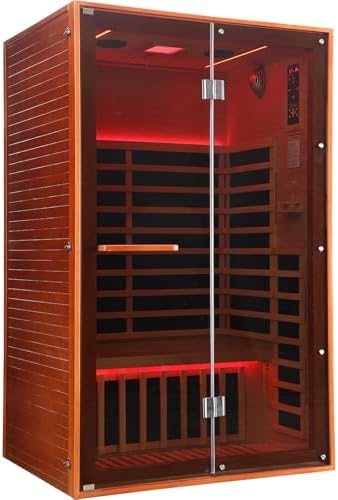
Prices across these 3 run from $1199.99 to $2580; each one has a full review here.
If you are new to sauna ownership, see our guide to the best portable sauna for beginners.


What happens if you under-buy or over-buy heating capacity?
Under-buying heating capacity results in a “dry” experience where the steam production rate cannot keep pace with the evaporation rate of the sauna environment. If the heating capacity is too low, the unit will exhaust its available water volume before the session ends, forcing the user to stop or manually refill the reservoir. This frequently occurs in larger steam tents where the volume of air to be humidified exceeds the output of a small heating element.
For those needing more steam, explore the best 2 person portable steam sauna options available.
Why excessive heating capacity can create uncomfortable humidity in small saunas
Over-buying heating capacity involves selecting a unit with a high heating capacity that exceeds the physical limitations of the sauna’s design. A high heating capacity means the unit can process a large volume of water, but if the steam tent or cabin is small, the humidity will peak too quickly, potentially making the environment uncomfortable or difficult to breathe in. While a larger capacity allows for longer sessions, it does not increase the speed of steam production; it only increases the total amount of water available to be converted into vapor over time.
If your primary goal is recovery, find the best infrared sauna for muscle tension in our comparison.
The common mistake with heating capacity and what to optimize instead
Many buyers mistake heating capacity for the total water reservoir size. Heating capacity measures the volume of water the heating element can process, while the reservoir size determines how much water the unit can hold before needing a refill. A unit might have a 3L heating capacity but only a 2L reservoir, meaning it can heat water quickly but requires frequent maintenance during a long session.
To understand the purification process, look at the best portable sauna for home detox options.
Balancing steam output rates with the size of the sauna setup
Instead of focusing solely on the heating capacity number, you should optimize for the steam output rate relative to your space. A high heating capacity is only useful if the steam output is sufficient to saturate the air in your specific area. For a small portable sauna, a 2.6L median heating capacity—which is the figure stated by 17 of the 149 portable sauna listings we evaluated—is often the sweet spot for balancing performance and portability. If you are using a large backyard sauna setup, you should prioritize a higher heating capacity to ensure the steam doesn’t vanish into the open air before it can be utilized.
Newcomers can start by learning what a portable sauna is and how it works today.
How heating capacity interacts with other deciding specs
Heating capacity interacts directly with the maximum temperature and the interior dimensions of the portable sauna. A high heating capacity allows a unit to reach its maximum temperature faster by processing water more efficiently, but it does not change the peak temperature itself. If a unit is rated for a high maximum temperature but has a low heating capacity, it may take a very long time to reach that heat level because it can only process a small amount of water at once.
You can also explore the specs in our full review of the 59C2 Infrared Sauna.
How sauna interior dimensions determine the required heating capacity
The interior dimensions of your sauna also dictate how much heating capacity you actually need. For example, if you are using a small steam tent, a 3.5L heating capacity might produce more steam than the small space can effectively hold, leading to a saturated environment that feels heavy. Conversely, in a larger backyard sauna, a 1.5L capacity will be insufficient to maintain any noticeable humidity. Do you need to maintain a consistent steam level for over an hour? In that specific scenario, the data suggests you should look for a capacity toward the 3.5L mark to ensure the supply of vapor does not run dry. If your goal is a quick 15-minute burst of heat, a 1.5L capacity is sufficient to provide the necessary steam for that duration.
For a budget-friendly tent option, see our full review of the X-Vcak Sauna Tent.
Power source limitations on the maximum heating capacity of portable units
Finally, heating capacity is often limited by the power source available to the portable sauna. High heating capacity requires significant energy to convert water to steam rapidly. If you are using a portable unit that relies on a standard household outlet, the heating capacity is often capped by the electrical draw allowed by that circuit. When comparing two units with similar heating capacities, check the power requirements to ensure the device can actually operate at its rated capacity in your home environment.
Browse our other portable sauna pages
LEDFacialMask.org is reader-supported: some links on this page are affiliate links, and as an Amazon Associate LEDFacialMask.org earns from qualifying purchases at no extra cost to you. Learn more.